
Empowering the Future: Advanced Robotics & Engineering with MATLAB
At Boyles Infosys, we leverage the world’s most powerful tools to solve the most complex problems. MATLAB (Matrix Laboratory) is more than just a programming language—it is a comprehensive ecosystem for engineers, scientists, and IT specialists driving the next generation of autonomous systems, cybersecurity, and digital healing.
🤖 The Robotics Revolution: Use Cases & Capabilities
In 2026, MATLAB has cemented its position as the gold standard for robotics development. We utilize these tools to bridge the gap between theoretical algorithms and real-world hardware.
-
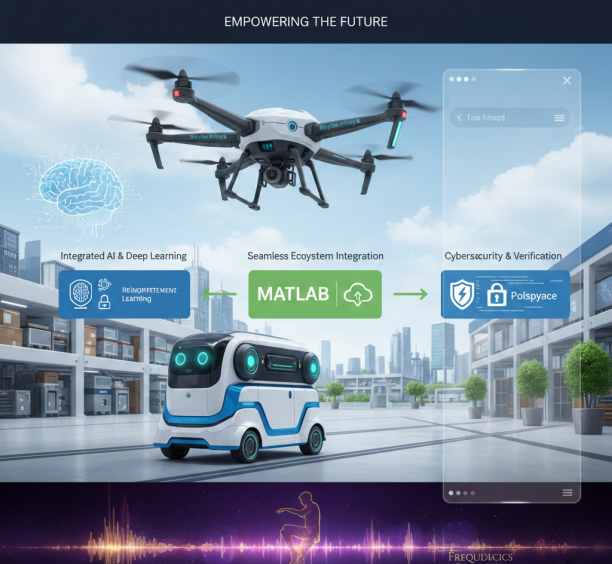
Autonomous Mobile Robots (AMR) & Drones: Using the Robotics System Toolbox, we design navigation and path-planning algorithms that allow robots to navigate complex environments. This includes SLAM (Simultaneous Localization and Mapping) for indoor logistics and Obstacle Avoidance for UAVs in defense scenarios.
-
Manipulator Kinematics & Collision Checking: For industrial and medical robotics, MATLAB provides precise control over multi-axis robotic arms. We can simulate Inverse Kinematics (IK) and collision-free paths before a single line of code touches the physical hardware.
-
Sensor Fusion & Perception: Modern robots rely on more than just cameras. MATLAB’s Sensor Fusion and Tracking Toolbox allows us to combine data from LiDAR, RADAR, IMU, and GPS to create a unified, high-fidelity view of the robot’s surroundings.
-
Digital Twins for Predictive Maintenance: We create high-accuracy digital twins of robotic systems. By simulating wear and tear, we can predict when a motor or joint will fail before it happens, minimizing downtime for our clients.
🚀 Key Software Features for 2026
MATLAB has evolved into a powerhouse of integration and speed, perfect for the high-stakes environments Boyles Infosys operates in.
🧠 Integrated AI & Deep Learning
AI is no longer an “add-on”—it is baked into the core of MATLAB.
-
Reinforcement Learning: Training autonomous agents to “learn by doing” in simulated environments.
-
Computer Vision: Automated object detection and semantic segmentation for surveillance and security.
-
2026 Update: The latest version features enhanced GPU acceleration, cutting neural network training times by up to 40%.
🔗 Seamless Ecosystem Integration
-
ROS & ROS 2 Support: Connect directly to the Robot Operating System to deploy standalone nodes or perform co-simulations with Gazebo.
-
Python & C++ Interoperability: Call Python libraries (like TensorFlow or NumPy) directly from MATLAB, or export MATLAB code into C++ for high-performance embedded systems.
-
Cloud-Native Workflows: Securely run large-scale simulations on the Boyles Infosys private cloud or public enterprise clusters.
🛡️ Cybersecurity & Verification
As specialists in cybersecurity, we value MATLAB’s Model-Based Design.
-
Automated Code Generation: We eliminate manual coding errors by generating production-ready C/C++ or HDL code directly from verified models.
-
Static Analysis: Use Polyspace tools within the MATLAB environment to prove the absence of critical run-time errors and ensure software safety in mission-critical defense applications.
🏥 Healing Frequencies: A Unique Intersection
At Boyles Infosys, we don’t just build systems; we build for humanity. Leveraging MATLAB’s unparalleled Signal Processing Toolbox, we explore the fusion of AI and Sound. By analyzing and generating specific Solfeggio and chakra frequencies, we are developing innovative methods for sound-based healing and education within the hip-hop culture.
Why Boyles Infosys? > By combining 20+ years of IT expertise with the precision of MATLAB, we deliver solutions that are not just “smart”—they are secure, scalable, and socially impactful.